
How to Remove and Store Your Pool Cover the Right Way
📅 March 30, 2026 · ⏱ 4 min read · ✍️ Dolphin Pool & Spa Team
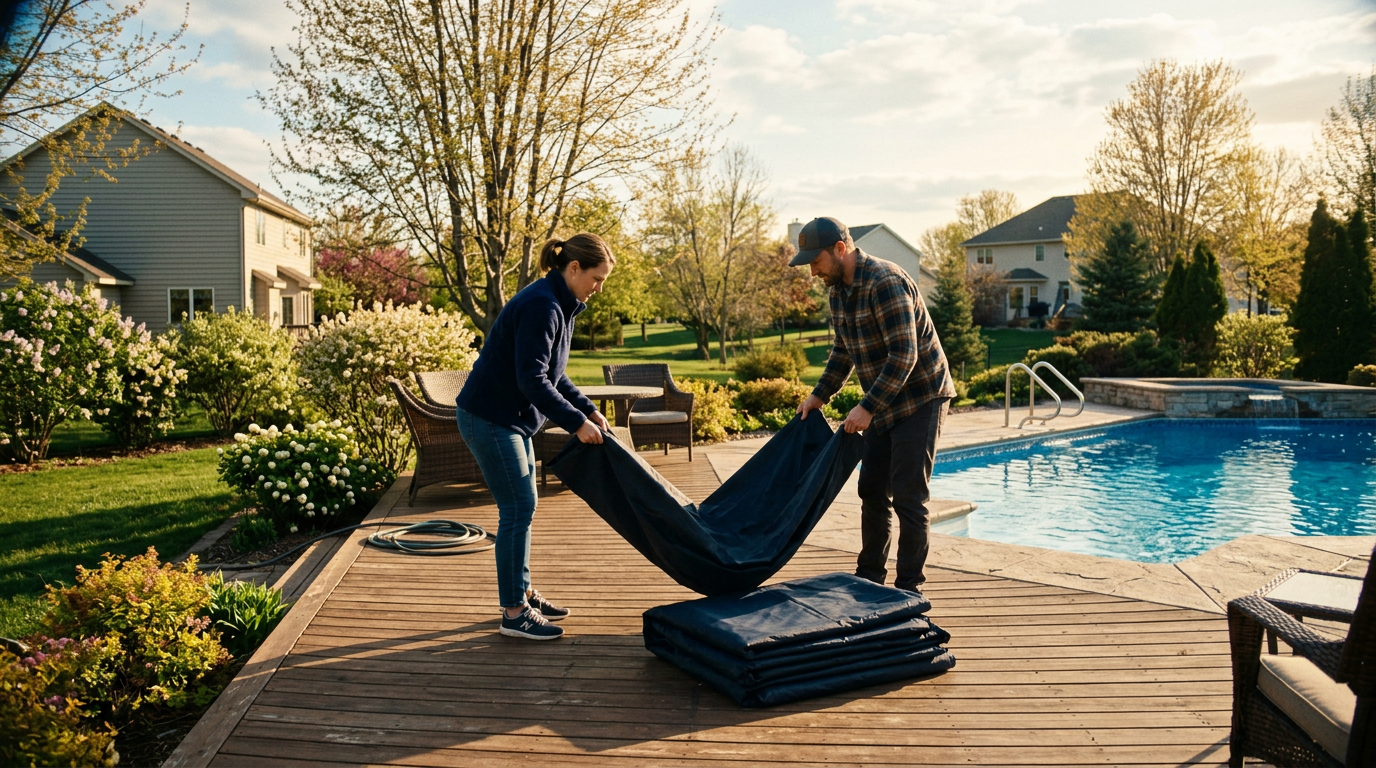
Images are AI generated and do not depict an actual pool or Dolphin Pool & Spa location.
Your pool cover just spent five or six months protecting your investment through a Minnesota winter. It kept out debris, blocked sunlight, and held up through freeze-thaw cycles, heavy snow, and everything else the season threw at it. Now it's time to take it off — and how you do that matters just as much as how you put it on. A cover that's removed and stored carelessly can be torn, molded, or permanently damaged before next fall ever arrives. Here's how to do it right.
Pro Tip from Dolphin Pool & Spa
Pick a dry, sunny day to remove your cover whenever possible. A cover that comes off dry is far easier to clean and store than one that's been soaked by recent rain. If your cover has a lot of standing water on it, run a cover pump the day before so you're not wrestling with hundreds of pounds of water on opening day.
1 Remove standing water first
Never attempt to pull off a cover that has water pooled on top of it. Even a few inches of standing water across a full-size pool cover can weigh several hundred pounds — and when you try to lift it, that water dumps directly into your freshly opened pool, bringing along every bit of algae, debris, and contamination that's been sitting on the cover all winter.
Use a submersible cover pump or an electric transfer pump to remove all standing water before you touch the cover. A wet/dry shop vac works well for smaller amounts. Take your time here — it's worth it.
2 Clear debris from the top
Once the water is gone, clear off any remaining leaves, twigs, pine needles, and debris before lifting the cover. A leaf blower works great for this — it's fast and keeps the mess on the cover rather than scattering it around your deck. A soft broom works too.
The goal is to get the top surface as clean as possible before you start folding. Anything left on the cover will end up pressed into the folds during storage and can cause staining and mildew over the summer.
3 Release all anchors and attachments
Before lifting anything, fully release every attachment point:
|
|
Heads up: Never yank or force a cover that still has anchor points engaged. Yanking a tethered safety cover tears the straps, bends the anchors, and can crack the deck around anchor points. Release everything fully before you lift a single edge.
4 Fold it — don't drag it
This is where most pool owners cause unnecessary damage. Dragging a pool cover across concrete or a rough deck surface is the fastest way to create tears, abrasions, and holes that will let in light and debris next winter. Once that damage starts, it doesn't stop.
Instead, fold the cover with two people — one on each side — using this method:
|
|
5 Clean the cover thoroughly
Before you put the cover away for the summer, clean it properly. A cover stored dirty will develop mold, mildew, and permanent staining over the next six months that shortens its lifespan significantly.
Lay it out flat on a clean section of lawn or driveway and wash it down with a garden hose. For algae, mildew stains, or mineral deposits, use a dedicated pool cover cleaner or a mild soap solution — avoid bleach or harsh chemicals that can degrade the cover material. Scrub gently with a soft brush if needed, then rinse completely.
Dolphin Pool & Spa Reminder
Stop in to see us at 3405 Hwy 169 N in Plymouth for pool cover cleaner and conditioner. A quality cover treatment applied before storage helps prevent the vinyl from drying out and cracking over the summer months — a small investment that adds years to your cover's life.
6 Dry it completely before storing
This step cannot be skipped. Storing a damp cover — even slightly damp — is the single biggest cause of mold and mildew that permanently stains and weakens cover material. Let the cover dry completely in the sun on both sides before folding it for storage. On a warm spring day this usually takes a few hours.
If you don't have time to let it dry fully on opening day, leave it spread out on the lawn and come back to it the next morning rather than rolling it up wet.
7 Store it correctly
Where and how you store your cover matters for both its condition and its longevity:
|
|
8 Inspect before you store — not next fall
Spring is the best time to assess your cover's condition because any damage from last winter is visible right now. Check for:
|
|
Small tears can often be repaired with a waterproof patch kit, which is worth doing if the rest of the cover is in good shape. But if your cover is showing widespread wear, brittleness, or multiple failures — it's better to plan for a replacement this fall rather than discover the problem at closing time when everyone else is also shopping for covers.
A quality safety cover treated well should last 10 to 15 years in Minnesota. A few extra minutes of care each spring is all it takes to protect that investment — and to make sure your pool is just as well protected next winter as it was this one.
Dolphin Pool & Spa Reminder
Need a new cover this fall? Stop in and see us at 3405 Hwy 169 N in Plymouth — we carry a full selection of mesh and solid safety covers for every pool size and shape. Buying early means you get the right cover, not just whatever's left in September.
Let us handle your opening this spring.
Dolphin Pool & Spa offers professional pool openings starting at $259.99. We handle everything — cover removal and storage, equipment startup, water testing, and a full safety check. Serving Plymouth and the greater Twin Cities area.
Schedule Your Opening →
Your Happy Dolphin Pool & Spa Team
Serving Minnesota pool owners since 1988 · 3405 Hwy 169 N, Plymouth, MN · 763-542-9000