
First-Time Pool Owner's Guide to Spring Opening in Minnesota
📅 April 6, 2026 · ⏱ 5 min read · ✍️ Dolphin Pool & Spa Team
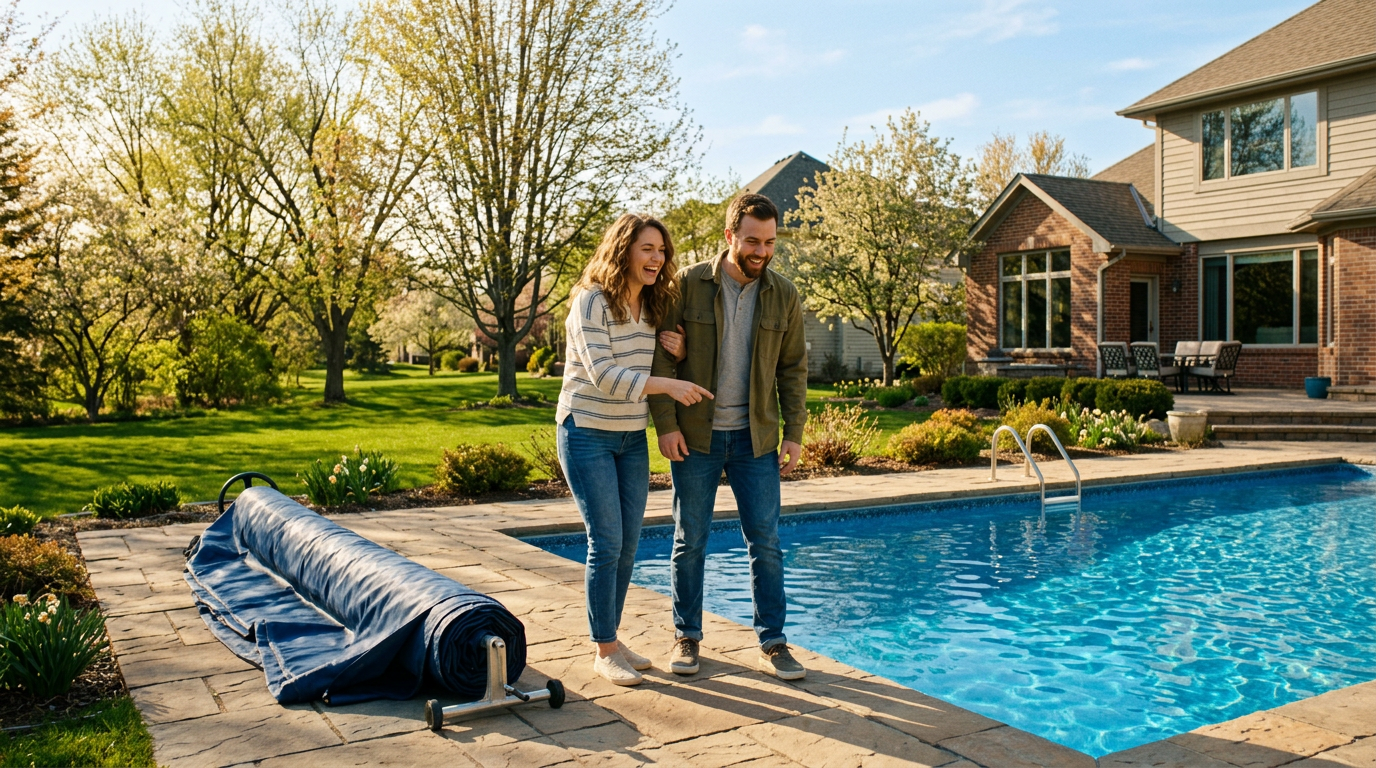
Images are AI generated and do not depict an actual pool or Dolphin Pool & Spa location.
Congratulations — you made it through your first Minnesota winter as a pool owner! Now comes the exciting part: getting that pool open and ready for summer. If this is your first spring opening, it's completely normal to feel a little overwhelmed. There are a lot of steps, a lot of chemicals, and a lot of equipment that all needs to work together. The good news is it's very manageable when you take it one step at a time — and we're here to help every step of the way.
Pro Tip from Dolphin Pool & Spa
As a first-time opener, bring a water sample into our store at 3405 Hwy 169 N in Plymouth after you've had the filter running for 24 hours. We offer free water testing with $50 in chemical purchases and will tell you exactly what your pool needs — no guesswork, no wasted money on chemicals you don't need.
1 Understand the difference between an open pool and a swimmable pool
Here's something most first-time owners don't realize going in: an open pool and a swimmable pool are not the same thing — and understanding the difference will save you a lot of frustration.
An open pool means the mechanical systems are up and running. The winterization plugs have been removed from the return lines and skimmer, the equipment plugs are back in place, water is circulating through the pump and filter, and everything is mechanically operational. You can achieve this on Day 1. It does not mean the pool is ready to swim in.
A swimmable pool means the water is balanced, sanitized, clean, and up to a comfortable temperature. Depending on your starting water condition and the outdoor temperatures, getting from open to swimmable can take anywhere from one day to several days. If your water is green, cloudy, or very cold, plan accordingly — it takes time to get chemistry balanced and algae cleared even with the filter running continuously.
Think of it this way — opening the pool is like turning the car on. A swimmable pool is the car warmed up, fueled, and ready to drive. The steps that follow in this guide take you through both stages in order.
If this feels like too much to take on solo your first year, that's completely valid. Our professional opening service starts at $259.99 and handles everything for you — including a full equipment inspection and water test. Many first-time owners start with a professional opening just to see how it's done, then take it over themselves in future years.
2 Gather everything before you start
Nothing slows down opening day like running to the store mid-job. Have all of this ready before you start:
|
|
3 Remove the cover carefully
Start by pumping any standing water off the top of the cover before lifting it — dumping that water into your pool brings algae and debris with it. Clear leaves and debris with a leaf blower, then release all anchor points before folding. Accordion-fold with two people toward one end of the pool, keeping the cover lifted off the deck surface as you go. Never drag it across concrete.
Once removed, rinse the cover on the lawn, let it dry fully in the sun, and store it in a breathable bag off the ground. A clean, dry cover stored properly will last years longer than one that goes into storage wet and dirty.
4 Inspect for winter damage before touching equipment
Before you reconnect anything, do a slow walk-around of the entire pool. Minnesota winters are hard on pools and catching damage now — before the system is running — is always cheaper than discovering it mid-season. Look for:
|
|
5 Reconnect equipment and fill to the right level
Remove all winter plugs from return lines and the skimmer. Reinstall eyeball fittings, skimmer baskets, ladders, and handrails. Lubricate all O-rings with silicone lubricant — never petroleum-based products, which break down rubber over time.
Fill the pool to the middle of the skimmer opening — roughly halfway up the tile line. This is important: don't start any equipment until the water level is correct. Running a pump without proper water flow even briefly can cause serious damage.
6 Start up the filtration system
Prime the pump according to your owner's manual and start it slowly. Listen carefully for grinding, cavitation, or unusual sounds. Check every visible fitting and connection for leaks while the pump is running. Run the filter continuously for at least 24 hours before testing water chemistry — fully circulated water gives you accurate test readings.
Heads up: If your pump won't prime, your heater won't fire, or you find a significant leak — stop and call a professional before continuing. Running equipment through a failure turns a small repair into a large one. Call us at 763-542-9000 and we can walk you through it or send someone out.
7 Test and balance your water chemistry
After 24 hours of circulation, test your water and adjust each parameter one at a time — wait at least 4 hours and retest between adjustments. Here are your target ranges:
8 Shock the pool — even if the water looks clear
Shocking is not optional at opening — even if your water looks perfectly clear. Over winter, bacteria and organic contaminants build up under the cover regardless of how well the pool was closed. Use a quality pool shock at the label-recommended dose, add it with the filter running, and let it circulate overnight before testing chlorine levels again.
9 Brush, vacuum, and clean everything
Brush all walls and the pool floor to break up any biofilm or early algae growth. Vacuum to waste so sediment is removed from the pool rather than cycled through your filter. Clean and rinse skimmer baskets. Backwash your sand or DE filter if pressure is elevated above the normal operating range.
10 Do a safety check before the first swim
Before anyone gets in the water, take 10 minutes to verify safety basics:
|
|
11 Common first-timer mistakes to avoid
Here are the most common mistakes we see from first-time pool owners at opening — all easy to avoid once you know about them:
Your first spring opening is a learning experience — and every year it gets easier and faster. By the end of your second season you'll have the whole process down cold and wonder what felt so complicated about it. When in doubt, come see us. We've been opening pools in Minnesota since 1988 and there's no question we haven't heard before.
Dolphin Pool & Spa Reminder
Stop in with a water sample after your first 24 hours of filtration and we'll test it for free with $50 in chemical purchases. We'll tell you exactly what to add, in what order, and how much — so you're not guessing on your first opening. We're at 3405 Hwy 169 N in Plymouth, open Monday through Saturday.
Rather let the pros handle your first opening?
Dolphin Pool & Spa offers professional pool openings starting at $259.99. We handle everything — cover removal, equipment startup, water testing, and a full safety check. It's a great way to see the whole process done right before taking it on yourself next year.
📞 Call Us Now — 763-542-9000
Your Happy Dolphin Pool & Spa Team
Serving Minnesota pool owners since 1988 · 3405 Hwy 169 N, Plymouth, MN · 763-542-9000