
Spring Pool Water Testing: What to Check First
📅 April 13, 2026 · ⏱ 4 min read · ✍️ Dolphin Pool & Spa Team
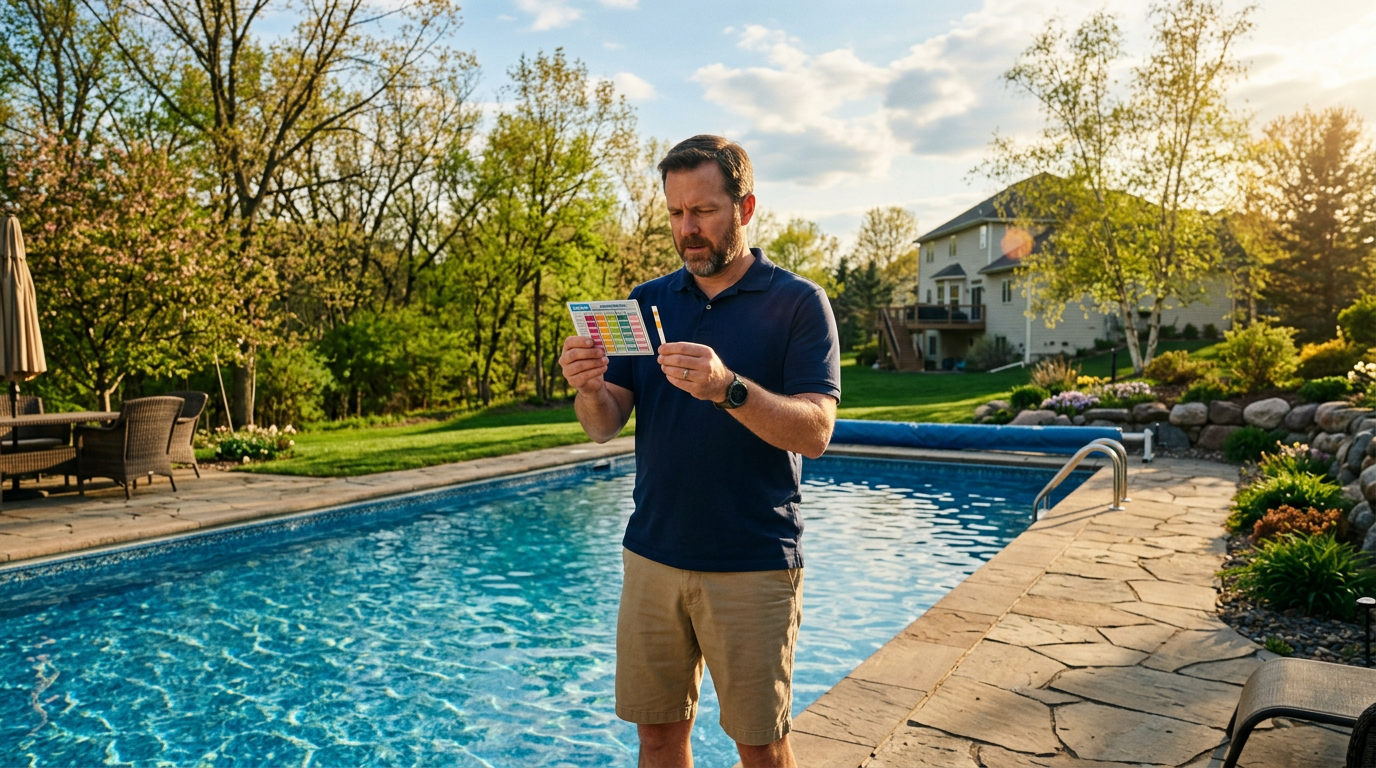
Images are AI generated and do not depict an actual pool or Dolphin Pool & Spa location.
You've got the cover off, the equipment running, and the pool filled to the right level. Now comes the part that determines whether you'll be swimming in crystal clear water this weekend or fighting cloudy, itchy, unbalanced water for the next two weeks — water testing. Getting your chemistry right at opening sets the foundation for the entire season. Here's what to test, what order to test it in, and what to do with the results.
Pro Tip from Dolphin Pool & Spa
Don't test your water the moment you open. Run your filter continuously for at least 24 hours first so the water is fully circulated and mixed — testing stagnant water gives you inaccurate readings that lead to wasted chemicals. Then bring a sample into our store at 3405 Hwy 169 N in Plymouth for a free water analysis with $50 in chemical purchases.
1 Test strips vs. liquid test kits vs. professional testing
Before we get into what to test, it's worth understanding your testing options — because not all methods give you the same level of accuracy:
For your spring opening, we strongly recommend a professional water test. Bring a sample in a clean bottle — collected from elbow depth in the middle of the pool, not near a return jet or the surface — and we'll give you a complete picture of every parameter with specific product recommendations and dosing instructions.
2 Test in the right order — it matters
Pool chemistry parameters are interconnected. Adjusting one affects others. The correct testing and adjustment order at opening is:
A note on wait times: Generic pool chemicals typically require you to wait up to 4 hours between doses before retesting — which can turn a one-day opening into a multi-day process. At Dolphin Pool & Spa we carry BioGuard, a professional-grade product line that only requires 15 minutes between doses. That means you can test, adjust, and retest multiple parameters in a single afternoon and have your pool balanced and swimmable significantly faster. It's one of the biggest practical advantages of using a quality product line over generic brands.
3 Total alkalinity — your foundation
Target range: 80–120 ppm
Total alkalinity is the measure of your water's ability to resist changes in pH. Think of it as the stabilizer for your stabilizer. When alkalinity is too low, pH bounces around wildly every time you add chemicals or swimmers get in. When it's too high, pH locks up and becomes almost impossible to adjust.
After a Minnesota winter, alkalinity is often low because the water has had months to drift. Raise it with BioGuard Balance Pak 100 (sodium bicarbonate). Lower it with BioGuard Lo 'N Slo (sodium bisulfate) — carefully and in small increments. Always adjust alkalinity before touching pH.
4 pH — the most important number
Target range: 7.4–7.6
pH is the single most critical parameter in pool chemistry. At the correct range, chlorine works efficiently, the water is comfortable for swimmers, and your pool surfaces and equipment are protected. Outside that range, everything suffers — low pH corrodes metal equipment and irritates eyes and skin; high pH renders chlorine nearly ineffective and causes scale and cloudiness.
Raise pH with BioGuard Balance Pak 200 (sodium carbonate). Lower it with BioGuard Lo 'N Slo (sodium bisulfate). Make adjustments in small doses — pH is easy to overcorrect.
5 Calcium hardness — protecting your surfaces
Target range: 200–400 ppm
Calcium hardness measures the amount of dissolved calcium in your water. Too low and the water becomes aggressive — it will literally pull calcium out of your pool surfaces, plaster, grout, and equipment to satisfy its hunger for minerals, causing etching and pitting over time. Too high and you get scale deposits on surfaces, cloudy water, and clogged filters.
Raise calcium hardness with BioGuard Balance Pak 300 (calcium chloride). Lowering it requires partial draining and dilution with fresh water — so it's much easier to keep this in range than to correct it once it climbs too high.
6 Cyanuric acid — protecting your chlorine
Target range: 30–50 ppm
Cyanuric acid (CYA), also called stabilizer or conditioner, protects chlorine from being destroyed by UV rays. Without it, direct Minnesota summer sunlight can burn off most of your free chlorine within a few hours. With it in the correct range, your chlorine lasts significantly longer and your chemical costs drop substantially.
At opening, CYA is typically low after winter dilution. Add BioGuard Stabilizer 100 (cyanuric acid granules) slowly through the skimmer with the pump running. Note that CYA dissolves slowly — allow 24 to 48 hours before retesting. Like calcium hardness, the only way to reduce CYA that has climbed too high is partial water replacement.
7 Free chlorine — your sanitizer
Target range: 1–3 ppm
Free chlorine is the active sanitizer in your pool — the chlorine that's available right now to kill bacteria, viruses, and algae. After all other parameters are balanced, bring your free chlorine into range with BioGuard Smart Sticks or BioGuard Silk Tabs (trichlor tablets) for your chlorinator, or BioGuard Smart Shock or BioGuard Shock Complete for a fast boost at opening. At opening you'll almost certainly find chlorine at zero — that's completely normal.
A note on total vs. free chlorine: if your total chlorine reading is significantly higher than your free chlorine reading, you have combined chlorine (chloramines) — the spent, ineffective form that causes that strong chemical smell and eye irritation. Shocking the pool breaks up chloramines and restores free chlorine to an effective level.
8 Shock — always the last step
After all parameters are balanced, shock the pool. Shocking raises free chlorine to a breakpoint level that destroys bacteria, organic contaminants, and chloramines that built up over winter. We carry four great BioGuard shock options depending on your needs — Burn Out Extreme and Burn Out 73 (calcium hypochlorite) for a powerful chlorine-based shock, and Smart Shock and Shock Complete for a fast-dissolving option that lets you swim in as little as 15 minutes. Double-dose any of these if your water was green or heavily contaminated at opening.
Add shock at dusk or at night with the filter running, and let it circulate for at least 8 hours before swimming. Never add shock directly to the skimmer if you have an inline chlorinator — the combination can cause a dangerous reaction.
9 Your complete spring target ranges at a glance
Water chemistry looks complicated on paper but becomes second nature after a season or two. The key is patience — test, adjust one thing, wait, retest. Resist the urge to dump in a bunch of chemicals at once. A methodical approach gets your pool balanced in a day or two, every time. And when you're not sure, we're always here to help.
Dolphin Pool & Spa Reminder
Bring a water sample into our store at 3405 Hwy 169 N in Plymouth after your first 24 hours of filtration. We test for all five parameters and give you a printed report with specific BioGuard product recommendations and exact dosing for your pool size. Free with $50 in chemical purchases — no appointment needed.
Skip the guesswork — let us test your water.
Bring a sample into Dolphin Pool & Spa and we'll give you a complete water analysis with exact product recommendations for your pool. Or call us and we'll walk you through your home test results over the phone. Getting your chemistry right at opening makes the whole season easier.
📞 Call Us Now — 763-542-9000
Your Happy Dolphin Pool & Spa Team
Serving Minnesota pool owners since 1988 · 3405 Hwy 169 N, Plymouth, MN · 763-542-9000