
Dealing with Pool Stains That Appeared Over Winter
Thursday, May 7, 2026 · Your Happy Dolphin Pool & Spa Team
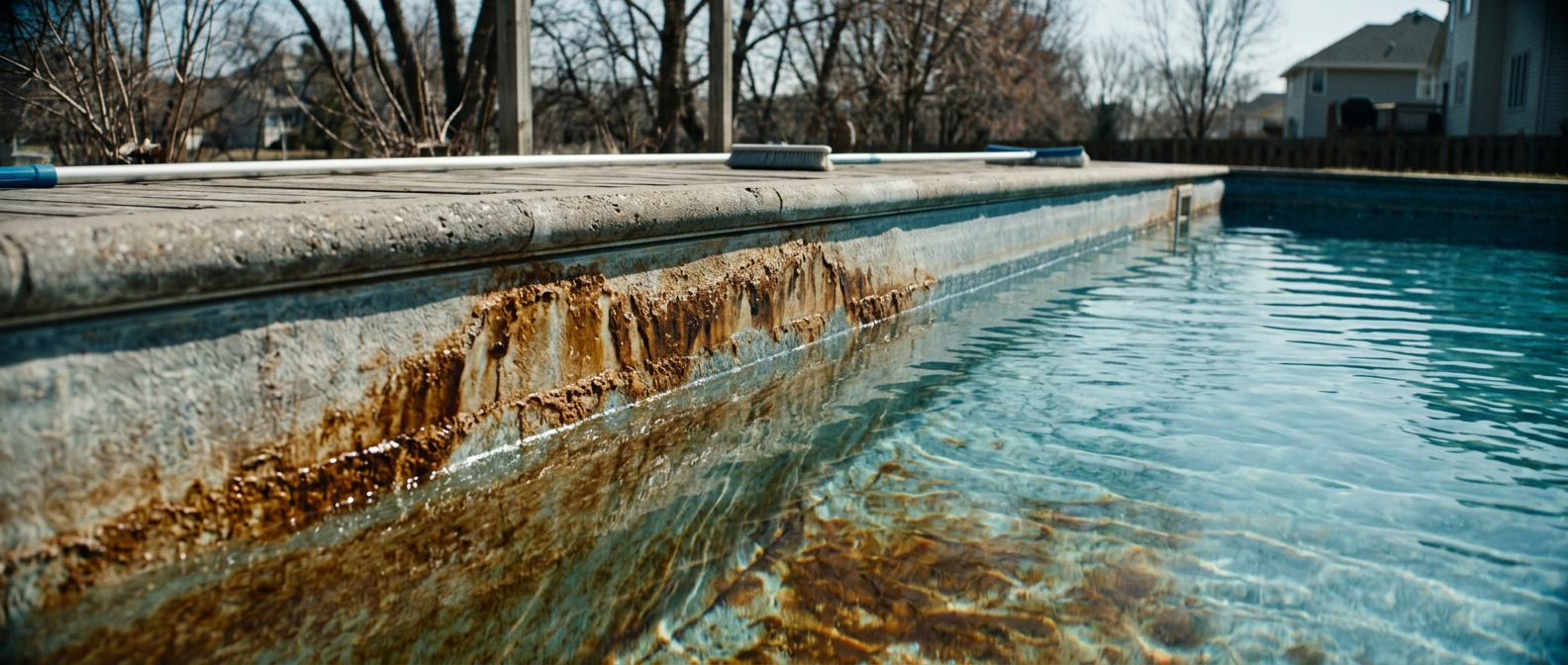
Images are AI generated and do not depict an actual pool or Dolphin Pool & Spa location.
You pull back the cover, peer into the pool — and there they are. Brown streaks along the waterline. Rust-colored blotches on the floor. A greenish tinge on the walls that wasn't there in September. Winter staining is one of the most common surprises pool owners face at opening, and the good news is that most of it is treatable if you identify it correctly and attack it with the right products.
The bad news? Using the wrong treatment on the wrong type of stain won't just fail to work — it can actually make things worse. Here's how to identify what you're dealing with and what to do about it.
1 Identify the Stain Type First
Pool stains fall into two broad categories — organic stains and metal stains — and they require completely different treatments. Treating a metal stain with an organic stain remover, or vice versa, is a waste of time and money. Here's how to tell them apart:
💡 Quick Field Test for Metal vs. Organic:
Take a small amount of granular shock and drop it directly onto the stain. If the stain lightens or disappears, it's organic — shock is working on it. If the stain darkens or turns darker brown/black, it's a metal stain — oxidizing it made it worse, which is your confirmation. Stop adding chlorine and switch to a metal treatment immediately.
2 How to Identify Algae Staining
Algae staining is one of the most misunderstood types of pool staining — mostly because by the time you open the pool in spring, the algae itself may be long dead, leaving only the stain behind. Here's how to tell if what you're looking at is algae-related:
|
|
⚠️ Important: If you have active algae — not just staining but cloudy water, slippery walls, or visible growth — deal with the algae first before treating for stains. Shocking and brushing to eliminate the algae is always step one. Stain treatment comes after the water is clear and chemistry is balanced.
3 Treating Organic Stains
Organic stains respond to oxidation. Once your water is balanced and your chlorine levels are in range, a good shock treatment will often fade or eliminate light organic staining on its own. For more stubborn organic stains — tannin staining from leaves that sat on the liner all winter, for example — make sure your chlorine is up, brush the affected areas, and give it time to work. Natural Chemistry Stain Free is also effective on many organic stains. Bring in a water sample and we'll help you build a treatment plan.
💡 Pro Tip: The faster you get your water chemistry balanced and chlorine working after opening, the less time organic stains have to set. Fresh organic stains are far easier to treat than ones that have been sitting in water for weeks. Don't delay your opening chemistry — it pays off in a cleaner liner.
4 Treating Metal Stains
Metal stains require a different approach entirely. Chlorine and shock make metal stains worse — oxidation causes dissolved metals to plate out onto pool surfaces more aggressively. If you have metal staining, you need to lower your chlorine before treating, and hold off on shocking for at least 4 days after treatment. We carry three products specifically for metal staining:
💡 Metal Stain Strategy — Think in Two Steps:
Step 1 — Remove: Use BioGuard Erase (iron) or Natural Chemistry Stain Free (iron and copper) to lift existing stains off the surface. Step 2 — Prevent: Follow up immediately with BioGuard Pool Magnet Plus and maintain a weekly dose throughout the season to keep metals sequestered. If you have metal in your source water — and many Twin Cities homes do — skipping the preventative step means the stains will be back by fall.
5 Get Your Water Tested First
Before you treat for anything, bring a water sample in to Dolphin Pool & Spa for a free water test. A full water analysis will tell you whether you have elevated metals in your water — which changes your entire treatment approach — and will make sure your chemistry is balanced before you add any stain treatment products. Adding stain removers to water that is out of balance is far less effective and can cause secondary problems.
✅ Free water testing with $50 in chemical purchases. Stop in with a sample from elbow-depth in your pool and we'll run a full analysis and build you a treatment plan. We carry BioGuard Pool Magnet Plus, Natural Chemistry Stain Free, BioGuard Erase, and everything else you'll need to get your pool looking great for the season.
Bring In a Water Sample — We'll Figure It Out.
Stain identification and treatment is one of the trickiest parts of pool ownership. We've been doing this since 1988 — bring in your water sample and a photo of the staining and we'll point you in the right direction. We're here Mon–Thurs 8–5, Fri 8–6, and Sat 8–4.
 Call Us Now — 763-542-9000
Your Happy Dolphin Pool & Spa Team
3405 Hwy 169 N, Plymouth MN · 763-542-9000 · dolphinpool-spa.com