
What Is a Pool Safety Inspection — and Why Spring Is the Time for One
Thursday, May 14, 2026 | Your Happy Dolphin Pool & Spa Team
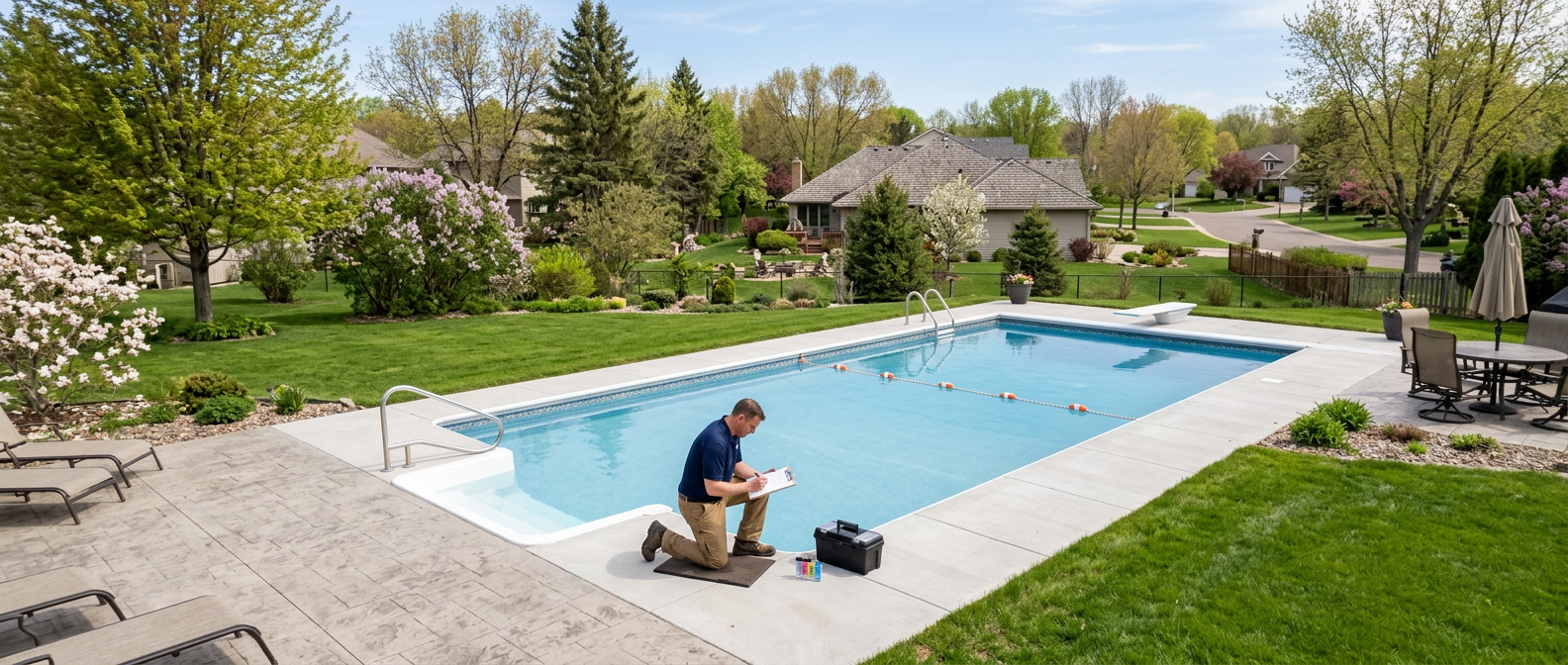
Images are AI generated and do not depict an actual pool or Dolphin Pool & Spa location.
Most pool owners think about safety when something goes wrong. A gate latch that fails. A drain cover that's come loose. A fence board kicked out over the winter. By then, of course, it's too late to be proactive.
Spring is the single best time to do a thorough pool safety inspection — before the cover comes off, before the kids are out of school, and before anyone is swimming. Everything is visible, nothing is under pressure, and any issues you find can be fixed before the season starts rather than during it.
Here's what a proper pool safety inspection covers — and what to look for at each step.
1 Pool Fencing and Gates
A proper pool fence is your first and most important layer of protection — especially for households with young children. Minnesota doesn't have a statewide residential pool fence law, but many municipalities and counties do, and your homeowner's insurance policy may require it regardless.
What to check:
- Fence height — most codes require at least 48 inches; check your local ordinance
- No gaps, broken boards, bent posts, or sections that have shifted over winter
- No climbable footholds within 36 inches of the top of the fence
- All gates self-close and self-latch — test every hinge and latch mechanism
- Gate latches open from the inside only, positioned near the top of the gate
- No gap between gate and post larger than 4 inches
⚠️ Heads Up: Freeze-Thaw Does a Number on Fence Posts
Minnesota winters are hard on post footings. Walk the entire fence line and push on each post — any that rock or lean need to be re-set before the season. A wobbly post means a compromised fence.
2 Drain Covers and Suction Outlets
Drain entrapment is one of the most serious — and preventable — pool hazards. The Virginia Graeme Baker Pool and Spa Safety Act (VGB Act) requires all public and residential pools to have compliant anti-entrapment drain covers. If your pool's drain covers are cracked, missing, or more than a few years old, this is not something to put off.
What to check:
- All drain covers are present, fully secured, and not cracked or broken
- Covers are VGB-compliant (look for the certification stamp on the cover)
- No covers are missing screws or sitting loosely in the fitting
- Main drain, any secondary drains, and spa suction outlets all inspected
💡 Pro Tip: When in Doubt, Replace It
Mandatory replacement timelines under the VGB Act apply to commercial and public pools — residential pools don't have the same federal requirement. That said, manufacturers typically rate drain covers for 5–7 years of service life, and a cracked, faded, or unidentifiable cover on any pool is a hazard worth fixing. If you can't confirm your cover is VGB-compliant, replacing it is the right call. Stop in and we can help you find the correct fit for your pool.
3 Ladders, Handrails, and Entry Points
Every point where someone enters or exits the pool is a potential hazard if the hardware isn't secure. This includes in-wall ladders, deck-mounted handrails, steps, and any ledges or benches.
What to check:
- All ladders and rails are fully secured with zero movement when pushed firmly
- No sharp edges, cracks, or broken welds on any metal hardware
- Step treads are seated, non-slip surfaces intact
- Rubber bumpers on ladder feet are present and in good condition
- Deck anchor cover plates are flush — no raised edges that become trip hazards
4 Pool Deck and Surrounding Area
The deck around your pool sees heavy foot traffic from wet, barefoot swimmers — and a Minnesota winter can leave it cracked, heaved, or uneven in ways that weren't there last fall.
What to check:
- Walk the entire deck and feel for raised edges, sunken sections, or cracks wide enough to catch a toe
- Check coping stones — any that have lifted, shifted, or cracked need attention before opening
- Look for drainage issues — standing water near the pool after rain increases slip risk
- Clear any debris, moss, or algae growth from deck surfaces that could become slippery
💡 Pro Tip: Mark Trip Hazards Before Opening Day
If you find a raised crack or uneven section you can't fix right away, mark it with a bright cone or tape so it's visible to anyone using the pool. A temporary fix is better than no fix — but schedule the repair before peak swim season.
5 Pool Lighting
Pool lights are both a safety feature and a liability. A non-functioning light means poor visibility for evening swimming. A light with a compromised fixture or conduit can create an electrical hazard in the water — which is as serious as it sounds.
What to check:
- All pool lights illuminate fully when switched on
- Light fixtures are fully seated and the lens gasket shows no signs of leaking
- No visible corrosion on the fixture housing or conduit entry point
- GFCI protection is in place and tests correctly at the breaker
- Deck light fixtures (if any) are intact with no cracked lenses or exposed wiring
⚠️ Heads Up: Pool Electrical Is Not a DIY Job
Any electrical work at or near the pool — replacing a light fixture, running new conduit, adding an outlet — must be done by a licensed electrician familiar with pool installations. The National Electrical Code has specific requirements for pool wiring, and violations aren't just illegal — they're dangerous.
6 Safety Equipment
Every pool should have basic rescue equipment within arm's reach — not stored in a shed, not across the yard. Spring is the time to pull it out, inspect it, and make sure it's ready to use.
7 Pool Rules — Post Them and Mean Them
A safety inspection isn't just about hardware — it's also about the human side of pool safety. Posted rules near the pool reinforce expectations, especially when kids invite friends over and you're not standing right there.
|
|
💡 Pro Tip: Walk the Rules With Your Kids Before Opening Day
Don't just post the rules — go through them out loud with your kids before the first swim of the season. Show them where the emergency shutoff is, where the rescue equipment lives, and what to do if someone gets in trouble. A five-minute conversation at the start of the season is worth more than a sign on a fence post.
8 When to Call a Pro
Most of a pool safety inspection is something any homeowner can do themselves. But there are situations where a professional set of eyes — or hands — is the right call:
- Any concern about electrical safety near the pool
- Drain covers that don't fit correctly or can't be identified as VGB-compliant
- Structural cracks in the pool shell, coping, or deck
- A fence or gate that can't be made to self-latch reliably
- Any hardware — lights, fittings, anchors — that you're not sure how to assess
At Dolphin Pool & Spa, our service team has been opening and inspecting pools in the Twin Cities since 1988. If you'd rather have a professional walk through your pool before opening day, we're here to help.
Let Us Help You Open Safe This Spring
From professional pool openings to safety hardware and water testing — Dolphin Pool & Spa has everything you need to start the season right. Stop in at 3405 Hwy 169 N in Plymouth or give us a call. We've been the Twin Cities' trusted pool store for over 35 years.
 Call Us Now — 763-542-9000
Your Happy Dolphin Pool & Spa Team
Serving the Twin Cities metro since 1988 | Plymouth, MN | 763-542-9000