
Variable Speed Pump Settings for Early Spring in Minnesota
Thursday, May 28, 2025 | Your Happy Dolphin Pool & Spa Team
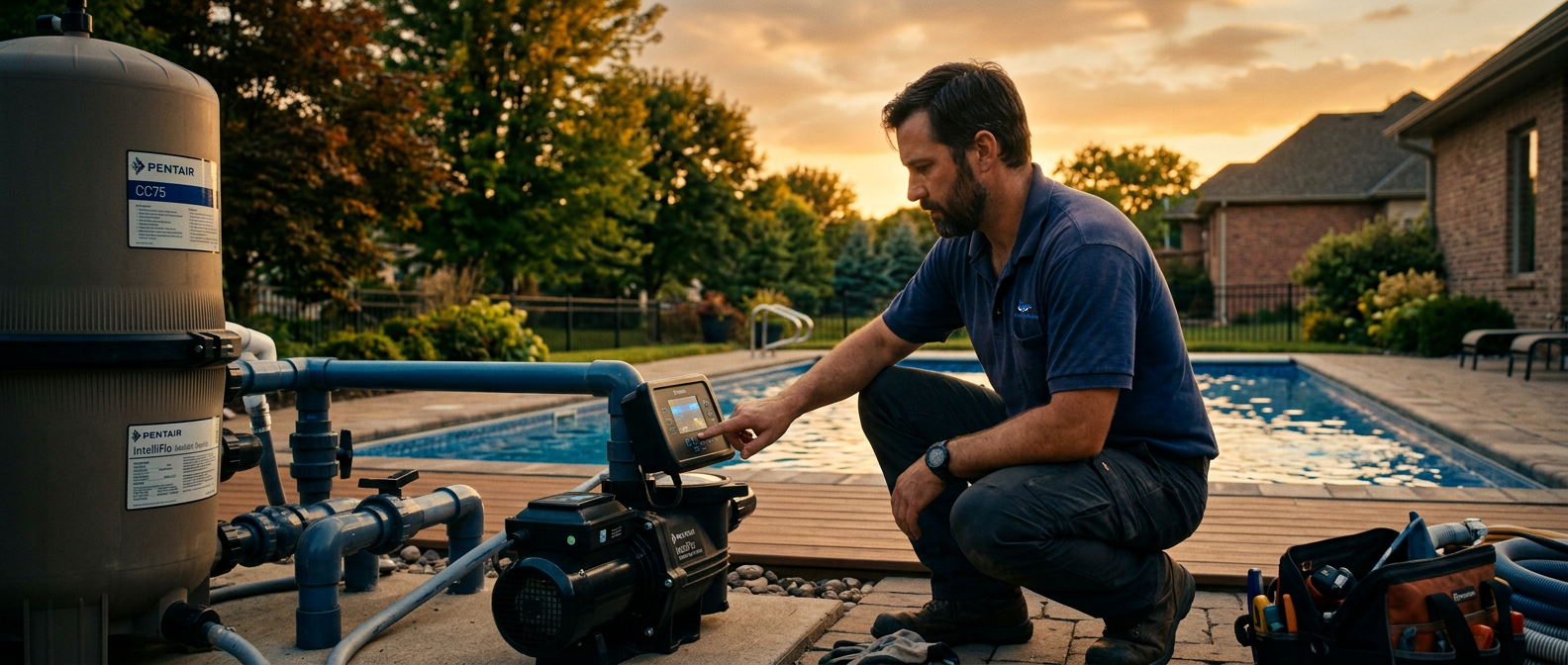
Images are AI generated and do not depict an actual pool or Dolphin Pool & Spa location.
Your variable speed pump is one of the smartest investments you've made in your pool — but only if you're running it at the right speeds for the right amount of time. In early spring here in Minnesota, the water is cold, bather loads are light, and your chemistry is just getting dialed in after opening. That means the settings that worked perfectly in August won't be right for May and early June.
Here's how to program your variable speed pump for early spring conditions so you get great circulation, protect your water quality, and keep your energy bill as low as possible.
1 Understand Why Spring Settings Are Different
Variable speed pumps (VSPs) save energy by letting you run at lower RPMs during off-peak hours and ramp up when you need heavy filtration, heating, or water features. In summer, higher speeds are often needed to keep up with heat, sunlight, heavy use, and chemical demand.
In early spring in Minnesota, conditions are very different:
The bottom line: your pool needs consistent circulation in spring, but it doesn't need to work as hard as it does during a hot July weekend. You can run lower RPMs for longer periods and still keep your water healthy.
2 Know Your Minimum Turnover Rate
The first rule of pump scheduling is making sure your water turns over enough times each day. Turnover rate is how long it takes your pump to move all the water in your pool through the filter one complete time.
To find how long you need to run your pump for a single turnover:
Quick Turnover Formula
Hours to turn over = Pool volume (gallons) ÷ Flow rate (GPH)
Example: 20,000-gallon pool ÷ 40 GPM (2,400 GPH at low speed) = ~8.3 hours for one turnover.
For residential pools, industry guidelines generally recommend a minimum of one full turnover every 8 hours — or roughly 2–3 turnovers per day during the swim season. In early spring with lighter use, one turnover per day is a reasonable starting point, but moving toward two as the season warms is better practice.
The principle is simple: the more your water circulates through the filter, the cleaner and safer it stays. One turnover only filters roughly 63% of the water. After two turnovers, you're at about 86%. After four, you're near 98%. More filtration is always better — the minimum is just a floor, not a goal.
Commercial Pools Are Held to a Stricter Standard
Residential pool owners can set their own turnover schedules, but public and commercial pools in Minnesota are governed by the Minnesota Department of Health under Minnesota Rules 4717.2560. That rule requires the entire pool volume to be recirculated in six hours or less — meaning at a minimum of four full turnovers per day, continuously, whenever the pool is in operation. Wading pools and splash pads have even tighter requirements (two hours or less), and spa pools must turn over every 30 minutes.
This stricter standard reflects the reality of commercial pools: higher bather loads, greater contamination potential, and the public health responsibility that comes with operating a facility open to the public.
That commercial standard is a useful benchmark for residential pool owners too. The more your water moves, the more it gets filtered and disinfected. Think of the commercial requirement as the gold standard — and let it inspire you to push toward more turnovers rather than fewer.
3 Recommended Spring Speed Settings
Most variable speed pumps allow you to program multiple speed levels on a timer. Here's a starting framework for early spring in Minnesota. Your exact RPMs may vary based on your pump model, plumbing size, and attached equipment — use these as a starting point and adjust from there.
Pro Tip: Run Your Pump During Off-Peak Hours
Xcel Energy customers in Minnesota can save on electricity by running your pump primarily between 9 pm and 9 am. Programming your low-speed overnight cycle to cover the bulk of your daily turnover is the single easiest way to cut your pool's energy costs.
4 Set a Higher Speed When Running Your Heater
If you're heating your pool to swim earlier in the season, your heater needs adequate flow to operate safely and efficiently. Running the pump too slow while the heater is on can trigger a flow error or cause the heater to shut down or run inefficiently.
Most gas and heat pump heaters require a minimum flow rate in the range of 25–40 GPM. Check your heater's manual for the exact minimum — then make sure your pump speed delivers at least that much flow whenever the heater is running.
Heads Up: Never Run the Heater at Low Speed
Running your heater while the pump is at 1,000–1,500 RPM can cause overheating, nuisance trips, or heater damage. Always make sure your heater speed setting (typically 2,500–3,000 RPM) is active before the heater fires. Many VSP controllers allow you to set a "heater interlock" speed — use it.
5 Run at Higher Speed After Adding Chemicals
Any time you add chemicals to your pool — especially shock — you want good circulation to distribute them evenly and prevent hot spots of concentrated chemicals near your return jets or skimmer.
After adding BioGuard products, bump your pump to medium or high speed for at least 30–60 minutes. Because BioGuard chemicals are formulated to dissolve and distribute quickly — with only a 15-minute wait between doses — you don't need to run high speed for hours. But good circulation in that first window is still key to even distribution throughout the pool.
The BioGuard Advantage
Generic pool chemicals can require up to 4 hours between doses — meaning you might need multiple separate days to balance your water after opening. BioGuard's professional-grade formulas only require 15 minutes between doses. That means you can test, treat, and re-test all in the same afternoon, with your pump running at a good medium speed throughout.
6 What to Watch For in the First Few Weeks
Your first few weeks after opening are a good time to observe how your pump is performing and fine-tune your schedule. Here's what to look for:
|
|
Heads Up: Cold Water Can Mask Problems
Cold water is naturally clearer and can hide early algae growth and chemistry issues that would be obvious in warmer water. Don't let a clear-looking pool trick you into skipping your weekly water test. Bring a sample in to us for a free water analysis with $50 in chemical purchases — we'll tell you exactly where your chemistry stands.
7 Transition to Summer Settings as the Season Warms
There's no single date to flip your pump settings from "spring mode" to "summer mode" — watch your water temperature and usage instead. As a general guide for Minnesota pools:
8 Building a New Pool? Circulation Starts at the Design Stage
If you're considering building a new pool — residential or commercial — the pump and circulation system aren't an afterthought. They're engineered into the design from day one. Pool volume, plumbing layout, pipe diameter, equipment pad placement, and the number and location of return jets all directly determine what your pump will need to do to achieve proper turnover rates for the life of the pool.
For commercial pools in particular, meeting Minnesota's MDH requirements under Minnesota Rules 4717 means the entire recirculation system must be engineered to achieve a full turnover every six hours or less — and that design has to be reviewed and approved by MDH before construction begins. It's not something you figure out after the pool is built.

Looking to Build? Talk to Minnesota Pools.
Our sister company, Minnesota Pools, specializes in building pools for apartment communities, hotels, and other commercial properties throughout the Twin Cities metro. Their sweet spot is practical, well-built commercial pools — think 20×40 with an attached spa, designed to meet MDH code and hold up to the demands of a multi-tenant property. They also build residential pools. If you're looking for a quality builder who knows commercial pool construction inside and out, give them a call.
Not Sure If Your Pump Settings Are Right?
We've been helping Minnesota pool owners get the most out of their equipment since 1988. Stop in at 3405 Hwy 169 N in Plymouth, bring us a water sample, and our team can help you dial in your pump schedule for the season — and make sure your BioGuard chemistry is exactly where it needs to be.
 Call Us Now — 763-542-9000
Your Happy Dolphin Pool & Spa Team
Serving the Twin Cities metro since 1988 | Plymouth, MN | 763-542-9000