
Saltwater Pool Spring Startup: What's Different?
Thursday, June 4, 2026 | Your Happy Dolphin Pool & Spa Team
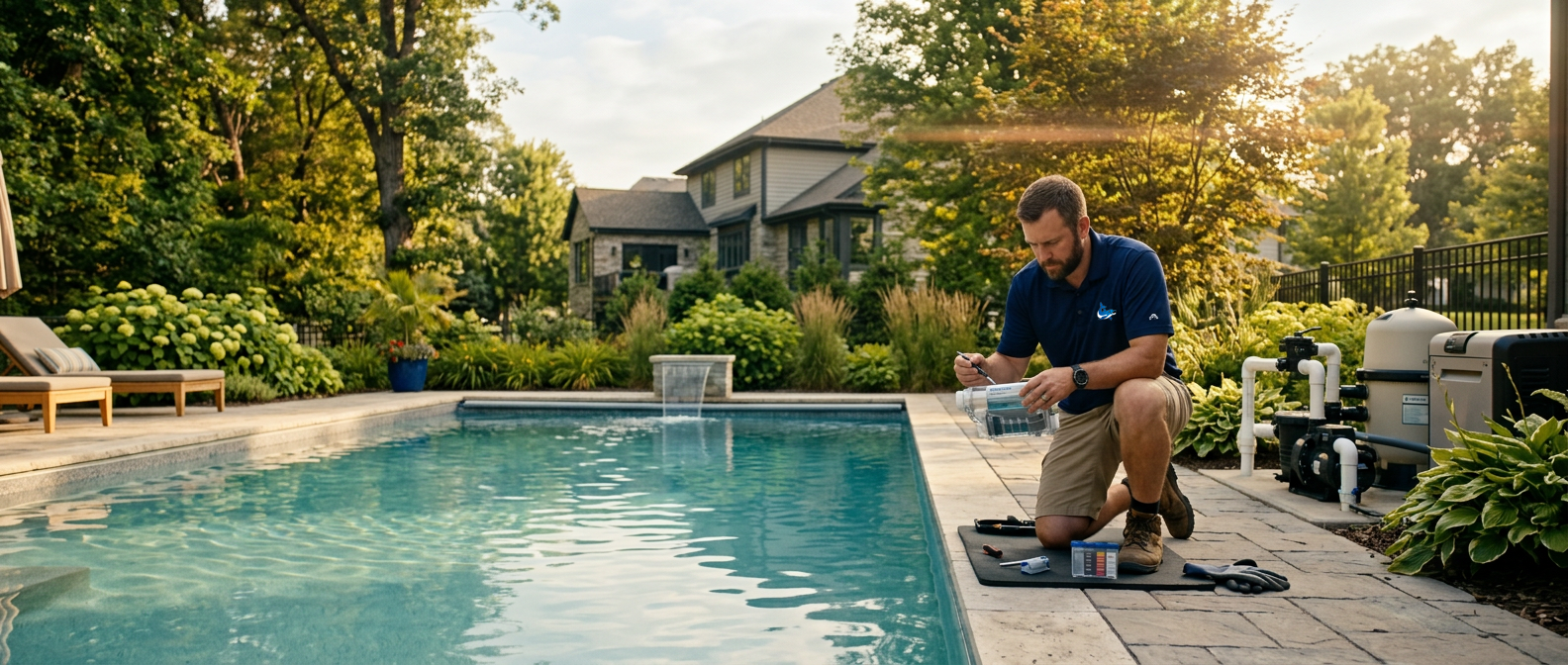
Images are AI generated and do not depict an actual pool or Dolphin Pool & Spa location.
If you own a saltwater pool, you already know the difference it makes all summer long — softer water, gentler on eyes and skin, and a more natural swimming experience. But spring startup for a saltwater system isn't quite the same as opening a traditional chlorine pool. There are a few extra steps, a few things to watch for, and a specific order of operations that sets you up for a smooth season. Here's everything you need to know.
1 Don't turn on your salt cell yet
This is the most important thing to remember about saltwater startup: your salt chlorine generator should be the last thing you turn on, not the first. Running a salt cell in cold water — generally below 60°F — can cause scaling on the cell plates and shorten its lifespan significantly. Minnesota pools often open when water temps are still in the 50s, so hold off on activating the cell until the water warms up.
Pro Tip: Most salt systems have a built-in water temperature sensor that will automatically disable chlorine production below a set threshold — usually around 50–60°F. Check your owner's manual so you know what your system's cutoff is, and don't try to override it.
2 Do a thorough equipment inspection
Before you fire anything up, walk through your equipment and give it a good look. Saltwater pools have a few components that deserve extra attention in spring:
|
|
3 Clean your salt cell if needed
If you see white, chalky deposits on the cell plates, it's time for a cleaning before startup. A diluted acid wash — typically one part muriatic acid to ten parts water — dissolves calcium scale quickly. Always add acid to water, never water to acid, and work in a well-ventilated area.
Heads Up: Many salt cell manufacturers sell purpose-built cell cleaning kits that make this process safer and easier. If you're uncomfortable working with muriatic acid, bring your cell in to us at Dolphin Pool & Spa — we're happy to walk you through it or help you find the right cleaning solution.
4 Test and balance your water chemistry
Saltwater pools need the same core chemistry targets as any pool, with one important addition: salt level. Get a full water test done before doing anything else — we offer free water testing at Dolphin Pool & Spa with $50 in chemical purchases. Here are the key ranges to hit:
Always balance in this order: alkalinity first, then pH, then calcium hardness, then CYA. BioGuard makes it easy:
- Balance Pak 100 to raise total alkalinity
- Balance Pak 200 to raise pH
- Lo 'N Slo to lower pH or alkalinity if either is running high
- Balance Pak 300 to raise calcium hardness
- Stabilizer 100 to raise CYA
Pro Tip: One of the biggest advantages of BioGuard products is that you only need to wait 15 minutes between doses — versus up to 4 hours with generic pool chemicals. That means you can balance your water at startup in a single session rather than spreading it across multiple days.
5 Check and adjust your salt level
Unlike CYA, salt doesn't evaporate — it's a mineral that stays in the water. The reason Minnesota saltwater pool owners almost always need to add salt in spring comes down to how we close pools here. To protect your skimmer body through our freeze-thaw cycles, we lower the water level below the return jets at closing. That water — and the salt dissolved in it — gets removed. When you refill in spring, you're diluting whatever salt remained. Use your salt system's built-in reading or an independent salt test strip to check where you're at, then add pool-grade salt to bring levels back into range.
Heads Up: Only use salt specifically labeled for pool use — food-grade or water softener salt are not the same formulation and can contain additives that interfere with your system. And once you've added salt, run the pump for at least 24 hours before checking the reading again — it takes time to fully dissolve and circulate.
6 Shock the pool manually before activating the cell
Even saltwater pools need a good opening shock. Your salt cell has been offline all winter, and the water needs a strong dose of chlorine to sanitize algae, contaminants, and organics that built up under the cover. Reach for a BioGuard shock product to get your free chlorine up to 10 ppm or higher before the cell takes over:
- Smart Shock — fast dissolving, swim re-entry in just 15 minutes
- Shock Complete — fast dissolving with built-in clarifier; also 15-minute swim re-entry
- Burn Out 73 or Burn Out Extreme — calcium hypochlorite for a heavy-duty opening shock if the water is particularly rough
Shock in the evening when UV levels are low, run the pump overnight, and retest in the morning. Once chlorine is in range and the water is clear, you're ready to bring the cell online.
7 Activate your salt cell and dial in the output
Once the water is above 60°F, chemistry is balanced, salt is in range, and chlorine is where it should be — turn the cell on. Start your output setting at around 50% and monitor free chlorine daily for the first week or two. In early June in Minnesota, UV load and bather load are both building, so you may need to creep the output up as the season kicks in.
Pro Tip: pH management is an ongoing job with saltwater pools. The electrolysis process naturally drives pH upward, so check it weekly and use Lo 'N Slo to bring it back down as needed. Keeping pH in range is also the single best thing you can do to extend the life of your salt cell.
8 If you have an automatic pool cover — read this carefully
⚠️ Your autocover can bleach and destroy your liner if the cover stays closed.
Saltwater pools — especially at startup when the cell is running at higher output to establish chlorine levels — can build up concentrated chlorine gas under a closed automatic cover. Without circulation and off-gassing, that chlorine-saturated air sits directly against your liner, and it will bleach it. We have seen this ruin liners that were only a few years old.
Open your automatic cover at least once a week — every week, all season long. Even if you're not swimming. Even if it's cloudy. Open it, let the water breathe and off-gas, run the pump with the cover open for a few hours, then close it again. This one habit will protect your liner and save you from a very expensive replacement.
9 Saltwater vs. traditional pool startup: a quick comparison
Questions about your saltwater system? We're here to help.
Bring a water sample into Dolphin Pool & Spa and we'll run a full analysis — free with $50 in chemical purchases. Whether you're troubleshooting a cell, adjusting salt levels, or just want to make sure everything is dialed in for summer, our team is ready to help.
 Call Us Now — 763-542-9000
Your Happy Dolphin Pool & Spa Team
Serving the Twin Cities metro since 1988 | dolphinpool-spa.com | 763-542-9000