
How to Handle a Pool Full of Rainwater and Debris After Winter
Monday, June 15, 2026 | Your Happy Dolphin Pool & Spa Team
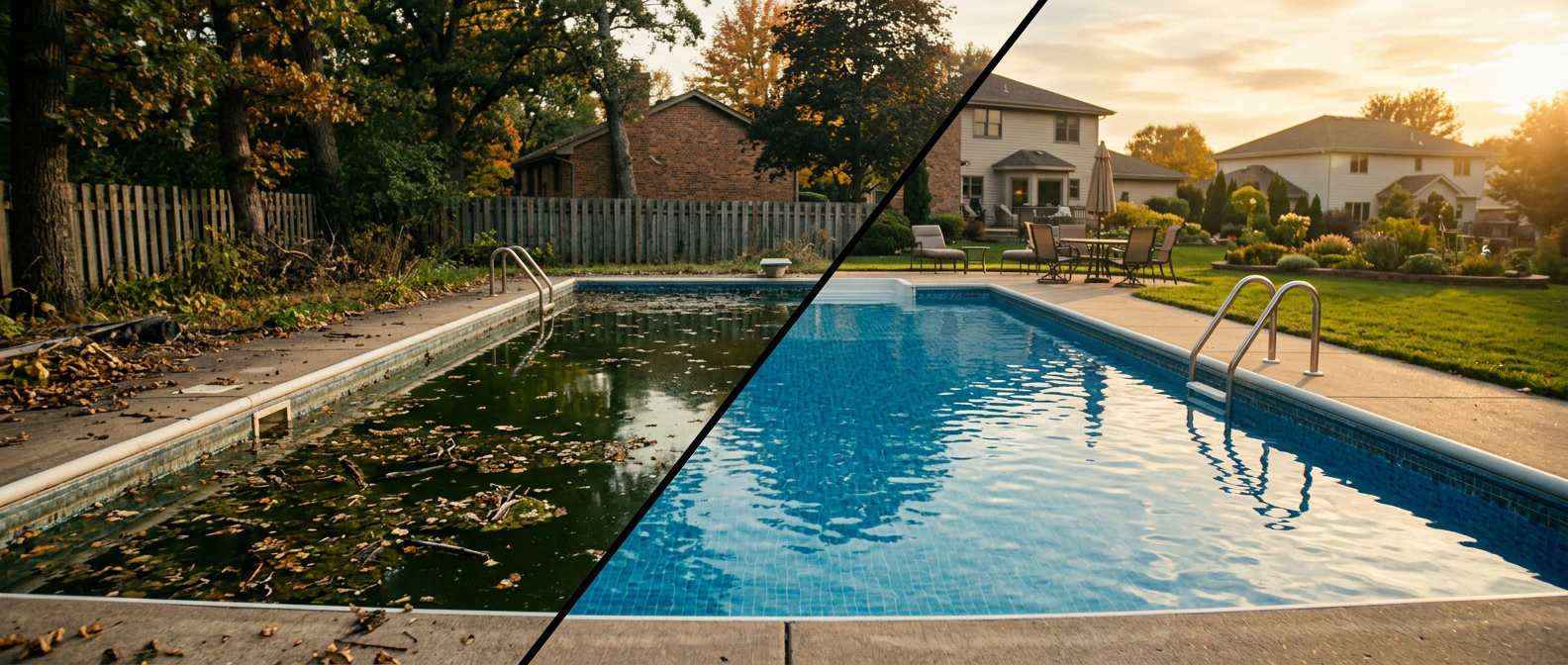
Images are AI generated and do not depict an actual pool or Dolphin Pool & Spa location.
You pull back the cover in spring and there it is — a pool full of dark, murky water, floating leaves, decomposing debris, and whatever else Minnesota winter decided to send your way. It's not pretty. But it's also not the end of the world.
A pool full of rainwater and debris after winter is one of the most common situations we hear about every spring in the Twin Cities. The good news: there's a clear process for dealing with it, and with the right approach — and the right products — you can go from swamp to swim-ready faster than you might think.
1 Why This Happens — and Why It's So Common
Minnesota pools sit closed for six months or more. During that time, a lot can accumulate on and around the cover:
|
|
💧 Remember: Open Does Not Mean Swim-Ready
Getting your pool open means getting it running — not getting it ready to swim in. When you're starting with a debris-filled, discolored pool, the path to swim-ready takes a few extra steps. Plan for it, and you won't be disappointed on day one.
2 Get the Equipment Running First
Before anything else, reinstall your winterizing plugs and get the equipment back online — pump, filter, and any other components you winterized. You need water circulating to do anything effectively. Run the filter continuously at this stage. You want maximum circulation while you work through the debris and chemistry.
💧 Pro Tip: Run the Filter 24 Hours a Day Until the Water Clears
When you're recovering a heavily soiled pool, this is not the time to run the filter on a timer. Keep it running around the clock until the water is clear. You can dial back to a normal schedule once things are looking good — typically 8–12 hours a day during swim season.
3 Check Your Water Level
Rainwater and snowmelt often push the water level above the skimmer opening. Check where the water sits — the proper level is halfway up the skimmer opening. Too high and the skimmer can't skim effectively; too low and you risk running the pump dry.
If you've already been running the pump to vacuum to waste, you're ahead of the game — just check the level before switching to normal filter mode. If the water is still high, continue draining on waste or use a submersible pump. If vacuuming to waste brought it down too far, top it off with the hose before running the filter normally.
4 Get the Debris Out
With the pump running and water level right, now tackle the physical debris. Leaves and organic matter are the enemy — they consume chlorine, fuel algae, and make everything harder. The more you remove manually, the less work your chemicals and filter have to do.
|
|
⚠️ Heads Up: Don't Vacuum to Filter When Water Is This Dirty
If your pool is heavily loaded with debris and sediment, vacuuming to waste — bypassing the filter entirely and sending water out through the backwash line — will save your filter from getting clogged immediately. You'll lose some water in the process, so have the hose ready to top it back up. If you're not sure how to set your filter to waste, give us a call and we'll walk you through it.
5 Test the Water and Start Balancing
Now it's time to find out what you're actually working with. Bring a water sample into Dolphin Pool & Spa for a computerized water test — $7, or free with $50 or more in chemical purchases. We'll tell you exactly where your water stands and what it needs, in what order.
For a pool that's been sitting all winter with heavy debris load, you'll typically need to address these in order:
⏱️ The BioGuard Advantage: Only 15 Minutes Between Doses
Generic pool chemicals can require up to 4 hours between each dose — turning a chemistry session into an all-day project. With BioGuard products from Dolphin Pool & Spa, you only need to wait 15 minutes between doses. When you're trying to recover a neglected pool, that time savings adds up fast.
6 Shock It — and Don't Be Shy
A pool that's been sitting with organic debris all winter needs a heavy shock treatment. This is not a situation for a maintenance dose — you need to hit the water hard to oxidize the organic load, kill algae, and get chlorine levels high enough to do their job.
BioGuard's shock lineup gives you options depending on how bad things are:
Always shock at dusk or after dark — sunlight burns off unstabilized chlorine quickly and reduces effectiveness. Run the filter overnight after shocking.
⭐ Spotlight: BioGuard Shock Complete — Our Favorite for Recovery
When your water is cloudy and recovering from a rough winter, Shock Complete is the product we reach for. Here's why it stands out:
- 4-in-1 formula — shocks, clarifies, flocculates, and prevents algae all in one dose
- Dissolves almost instantly — it's gone before it even reaches the floor, so no bleaching or spotting on your liner
- Non-calcium formula — won't contribute to scale buildup or cloudiness from calcium precipitation
- Improves filter efficiency — binds fine particles together so your filter can capture them more easily
- 15-minute swim re-entry — fastest re-entry time of any calcium hypochlorite shock
For a pool that needs to go from murky to clear as fast as possible, Shock Complete does more work per dose than any other shock in our lineup.
Dolphin Pool & Spa — In-Store Coupon
10% Off a Box of BioGuard Shock Complete
Valid on a full box purchase. Print or show this page at the register. One coupon per customer. Not combinable with other offers.
3405 Hwy 169 N, Plymouth MN 55441 | 763-542-9000 | dolphinpool-spa.com
7 Follow Up with Algaecide and Keep Filtering
After shocking, add a dose of BioGuard Algae Complete or Back Up algaecide to prevent any surviving algae from coming back while the water clears. Then keep that filter running.
As the water clears you'll likely need to clean or backwash your filter — it's doing a lot of heavy lifting right now. Check the pressure gauge and backwash when it climbs 8–10 psi above your clean starting pressure. Repeat as needed over the next several days until the water is clear.
Here's what the recovery progression typically looks like — and what it means:
⚠️ Heads Up: This Process Takes Time — Plan for Several Days
Recovering a heavily soiled pool isn't a one-day job. Depending on how bad things are, clearing the water can take anywhere from two days to a week of continuous filtration, chemical treatment, and filter cleaning. Be patient and consistent — it will get there. If you're not seeing progress after a few days, bring another water sample in and we'll adjust the plan.
Don't Go It Alone — We're Here to Help
A rough spring opening doesn't have to derail your whole season. Stop in with a water sample and we'll run a full computerized test and build you a step-by-step recovery plan. Our staff has seen every version of this situation — and we know exactly how to get your water back on track. Water testing is $7, or free with $50 or more in chemical purchases.
 Call Us Now — 763-542-9000
Your Happy Dolphin Pool & Spa Team
3405 Hwy 169 N, Plymouth MN 55441 | 763-542-9000 | dolphinpool-spa.com