
Summer Pool Maintenance: Your Weekly Checklist
Monday, June 22, 2026 | Your Happy Dolphin Pool & Spa Team
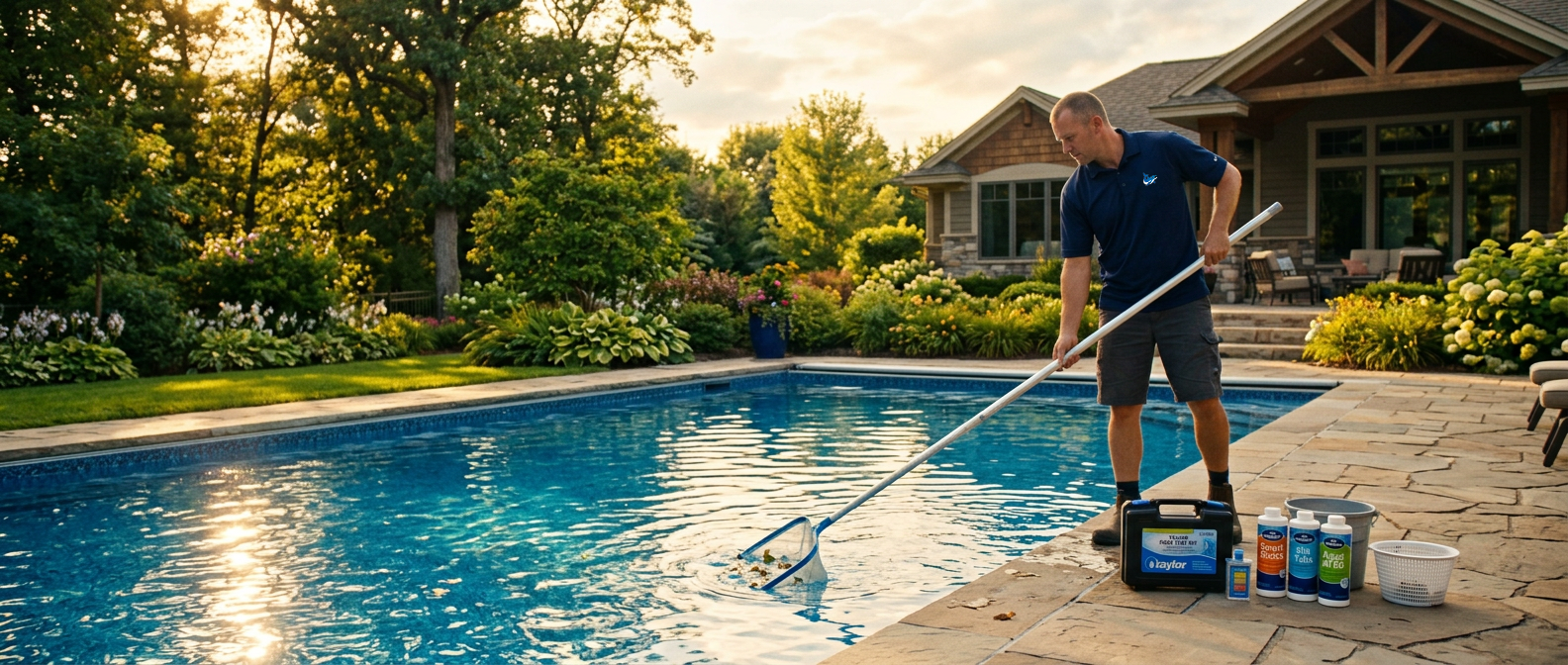
Images are AI generated and do not depict an actual pool or Dolphin Pool & Spa location.
Summer in Minnesota is short, and the last thing you want is to spend it chasing water problems instead of enjoying your pool. The good news? Keeping your pool clean and balanced all summer long isn't complicated — it just takes a little consistency. A simple weekly routine takes less than an hour and saves you from the time, cost, and frustration of dealing with algae, cloudy water, or chemistry gone sideways. Here's exactly what to do — and when to do it.
💧 Why Weekly — Not Monthly?
Pool water changes fast in summer. Heat accelerates chemical consumption, UV burns off chlorine, and bather load adds contaminants every single day. A pool that looks fine on Monday can be heading toward green by Friday if nothing is checked. Weekly attention is what keeps small problems from becoming big ones.
1 Test Your Water
Testing is the foundation of everything else. Without knowing where your water is, you're guessing — and guessing with pool chemistry costs money. Test at least once a week during peak summer, and more frequently during heat waves or after heavy use.
What to test every week:
🧪 Pro Tip: Bring a Water Sample In
At-home test strips are great for quick weekly checks, but a professional water analysis catches things strips miss — including phosphates, metals, and combined chlorine. Bring a sample into Dolphin Pool & Spa for a full analysis. Water testing is $7, or free with $50 or more in chemical purchases.
2 Adjust Chemistry as Needed
Once you know where your water is, correct anything that's out of range. One of the biggest advantages of BioGuard chemistry is the 15-minute wait time between doses — where generic store-brand chemicals require up to 4 hours between applications, BioGuard lets you address multiple issues in the same session without turning a chemistry day into an all-day event.
BioGuard balancers to keep on hand all summer:
|
|
⚠️ Always Balance Before You Shock
Adjust your pH and alkalinity before adding shock. Shocking a pool with out-of-range pH reduces the effectiveness of the shock significantly — and wastes product. Get your chemistry dialed in first, then shock.
3 Shock Weekly
Shocking isn't just for green water or pool parties — it's a regular part of summer maintenance. Weekly shocking destroys combined chlorine (chloramines), burns off organic contaminants, and keeps your water sparkling. Think of it as a reset button for your pool.
BioGuard makes it easy to shock without clearing the pool for hours. Smart Shock and Shock Complete both allow swimmers back in the water in just 15 minutes — compared to the 4-hour wait required by generic shock products. Shock Complete also includes a built-in clarifier, so it does double duty on hazy water.
⏱️ Shock the Night Before
Shock works best overnight — there's no UV to burn it off, and it has hours to do its job before the next swim day. Add shock after sundown on Thursday or Friday, and your pool will be ready and balanced for the weekend.
4 Add a Weekly Algaecide
Algae is much easier to prevent than to cure. A weekly dose of algaecide keeps algae from ever getting a foothold — especially in the heat of a Minnesota summer when water temperatures are at their highest and algae growth is at its fastest.
Our recommendation is BioGuard Algae Complete — and there's a reason it's the one we reach for first. It handles both prevention and active treatment in a single product, meaning it protects a clean pool and fights back if algae starts to form. You don't have to guess which problem you have or grab a different bottle depending on the situation. Add it once a week on the same day you shock, and you're covered.
There are other algaecides on the market — including basic preventative-only options like BioGuard Back Up — that cost a little less. If budget is the priority, they'll do the prevention job. But if you want one product that does it all and gives you a margin of protection when life gets busy and you miss a week, Algae Complete is worth it.
5 Skim, Brush, and Vacuum
Physical cleaning works with your chemistry — not instead of it. Debris left sitting on the bottom or stuck on walls can harbor algae and introduce organics that eat up your chlorine. A few minutes of mechanical maintenance each week goes a long way.
|
|
6 Check Your Filter
Your filter is doing the heavy lifting all summer long — check the pressure gauge weekly. A reading 8–10 psi above your clean starting pressure means it's time to backwash (sand or DE filter) or rinse (cartridge filter). Running a dirty filter makes your whole system work harder and reduces water quality.
⚠️ DE Filter Owners: Re-add Powder After Every Backwash
After backwashing a DE filter, you must add fresh DE powder through the skimmer to recoat the grids. Skipping this step leaves your filter running without a filtration medium — it will look like it's working but won't be filtering properly.
7 Check the Water Level
Between evaporation and splash-out, pool water levels can drop faster than you expect — especially during hot, busy weeks. The water level should sit at the midpoint of the skimmer opening. Too low and the skimmer pulls air, which can damage your pump. Too high and the skimmer can't function properly.
Top off with your garden hose as needed. If you're adding more than a few inches per week, you may have a slow leak worth investigating.
Your Summer Weekly Maintenance At-a-Glance
We're Here All Summer Long
Whether you need a water analysis, a refill on BioGuard chemicals, or advice on what's going on with your pool, the Dolphin team is here Monday through Saturday. Stop in or give us a call — we make pool ownership a joy!
3405 Hwy 169 N, Plymouth MN 55441 | Mon–Thurs 8–5, Fri 8–6, Sat 8–4
 Call Us Now — 763-542-9000
Your Happy Dolphin Pool & Spa Team
Serving the Twin Cities metro since 1988 | dolphinpool-spa.com