
The Science of a Cannonball: What Really Happens When You Hit the Water
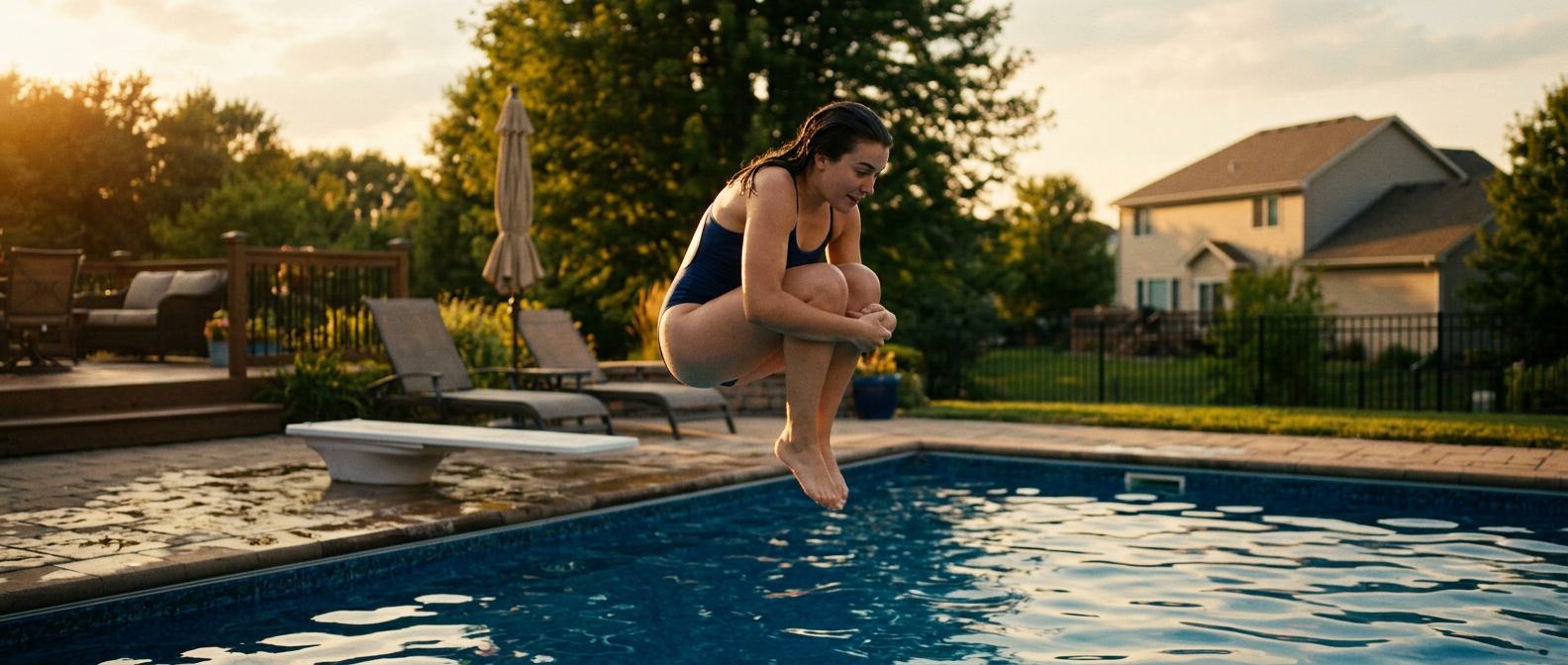
Images are AI generated and do not depict an actual pool or Dolphin Pool & Spa location.
Every backyard pool has a resident cannonball champion — the kid (or dad) who's convinced they can soak the entire patio in one jump. It turns out there's real fluid dynamics behind that splash, and understanding it can actually make you a sharper, more hands-on pool owner. Let's break down what's really happening the moment a body meets the water, and what that same "big splash energy" means for your pool's chemistry after a long day of jumping.
1 The Physics of Displacement
Cannonballs are really just a live demonstration of Archimedes' principle: any object entering water pushes aside a volume of water equal to the volume of the object (plus the air pocket it drags down with it). A tucked-up body entering fast and flat displaces more water more violently than a streamlined dive, because it's presenting maximum surface area to the water all at once instead of slicing through it.
That violent displacement doesn't just push water sideways — it also drags a pocket of air down with the body. When that air pocket collapses and rushes back to the surface, it launches a ring of water upward. That's the "splash crown" you see photographed in slow motion, and it's a well-documented phenomenon in fluid dynamics research on solid objects hitting liquid surfaces.
2 Why the "Sit and Pull" Technique Works
Serious cannonball technique — knees pulled to chest, arms wrapped tight, then a hard pull-and-release right at entry — isn't just showmanship. Tucking maximizes the flat surface area hitting the water first, and the sudden "pull" motion at the moment of impact shoves additional water outward right as the air cavity is forming. More surface area plus a sharper outward push at the exact right instant equals a taller, wider splash crown.
3 What a Pool Party Really Does to Your Water Chemistry
Splashing aside, the bigger chemistry story is bather load. Every swimmer brings in sunscreen, sweat, skin oils, and body lotion — organic material that eats up your chlorine's ability to sanitize. A yard full of kids cannonballing for three hours puts far more demand on your sanitizer than a quiet solo swim, and the increased surface agitation from all that splashing also speeds up chlorine off-gassing into the air.
The good news: you don't have to wait around for your pool to recover. Generic shock products need up to 4 hours before it's safe to get back in the water. BioGuard Smart Shock and Shock Complete are fast-dissolving formulas that only require a 15-minute wait — so you can shock the pool right after the party breaks up and have it swim-ready again the same evening.
The Physics of a Big Splash
|
The Pool Care Aftermath
|
Had a big cannonball weekend? Bring in a water sample and let us check your levels before the next round of jumps — testing is $7, or free with a $50+ chemical purchase. Whether it's a quick balance check or a full BioGuard shock, we make pool ownership a joy!
 Call Us Now — 763-542-9000