
Evaporation Math: How Much Water Is Your Pool Actually Losing This Month?
August 10, 2026 | Your Happy Dolphin Pool & Spa Team
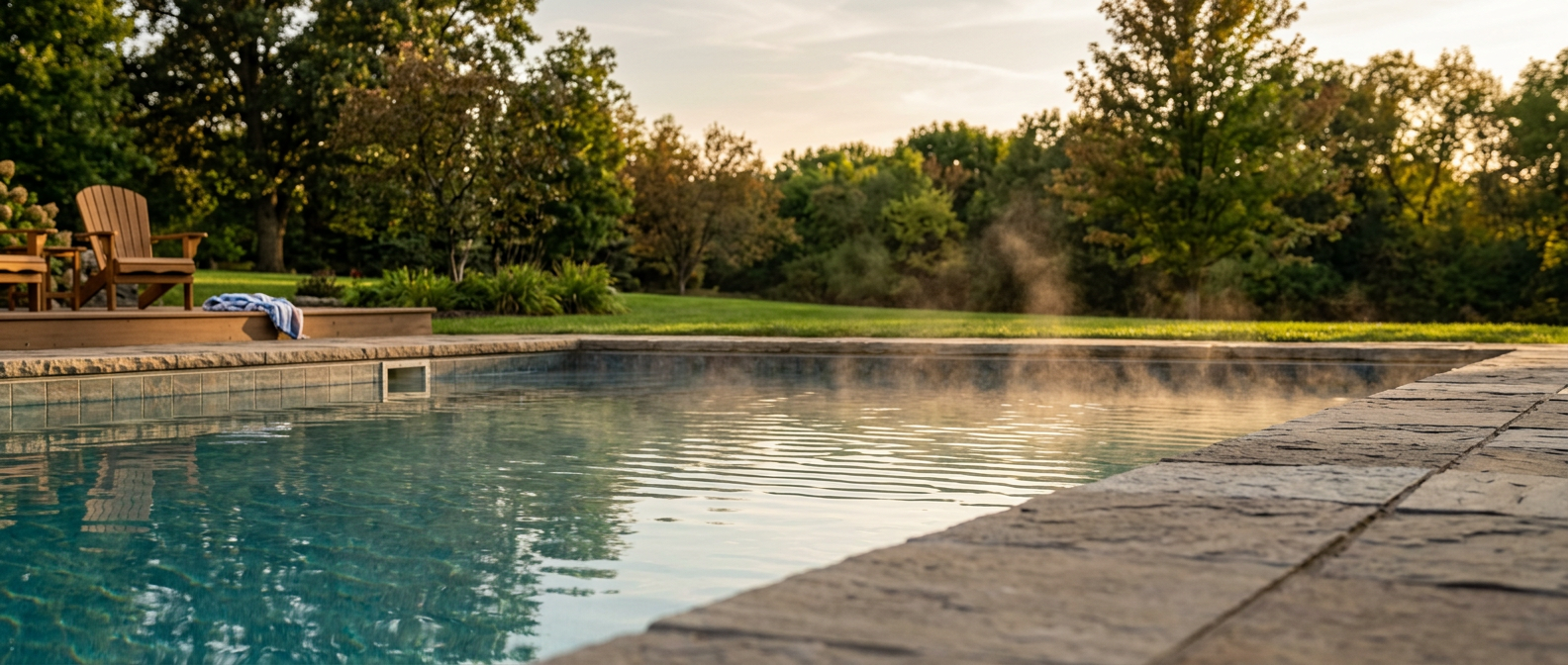
Images are AI generated and do not depict an actual pool or Dolphin Pool & Spa location.
Your pool loses water every day. You don't see it go. No splash, no drip, no sound. But by the end of August, your pool could lose hundreds of gallons and you'd never spot a single drop leaving the water. Let's do the math and find out where it's going.
1 The Rule of Thumb
Heat pulls moisture off the surface of your pool and sends it into the air. On a calm, mild Minnesota day, most pools lose about a 1/4 inch of water. On a hot, dry, windy day, that number can climb to 1/2 inch or more.
A quarter inch sounds small. Spread across your whole pool surface, it isn't.
2 Do the Math for Your Pool
Here's the formula. Take your pool's surface area in square feet. Multiply by the inches of depth you lost. Divide by 12 to turn inches into feet. Multiply by 7.48, the number of gallons in a cubic foot.
Gallons lost = ((surface area (sq ft) × inches lost) ÷ 12) × 7.48
Try it on a standard 16 by 32 foot pool. That's 512 square feet of surface.
On a normal day, at a quarter inch: ((512 × 0.25) ÷ 12) × 7.48 ≈ 80 gallons.
On a hot, windy day, at a half inch: ((512 × 0.5) ÷ 12) × 7.48 ≈ 160 gallons.
Up to 160 gallons, gone in a single day. And your pool never looked one bit different.
3 What Speeds It Up, What Slows It Down
|
Speeds it up
|
Slows it down
|
4 Evaporation or Leak? Try the Bucket Test
Not sure if you're looking at plain evaporation or an actual leak? Run the bucket test.
Fill a bucket about two-thirds full and set it on a pool step, so the water inside the bucket sits at the same level as the water in your pool. Mark both water lines with a strip of tape, one inside the bucket, one on the pool tile or the outside of the bucket. Let the pump run like normal. Wait 24 to 48 hours.
Compare the two lines. If your pool dropped about the same amount as the bucket, that's just evaporation. If your pool dropped noticeably more than the bucket, you likely have a leak. For a professional leak locate, American Leak Detection of Minneapolis can pinpoint the source.
Heads up: if your water level drops below the skimmer opening, your pump can suck air instead of water. That can burn out the motor fast. Keep an eye on the level and top off before it gets too low.
5 Top Off and Keep Your Chemistry Balanced
When you add fresh water to replace what evaporated, your chemistry shifts too. Chlorine, pH, and alkalinity all move a bit with a big top-off. Retest after every one.
Stop in for a water test — $7, or free with a $50 or more chemical purchase — and we'll get your numbers back where they belong before it turns into a bigger job.
Whether it's evaporation, a leak, or chemistry that's drifted from a big top-off, our team can help you sort it out. From testing to Balance Pak products to full-service checkups, we make pool ownership a joy!
 Call Us Now — 763-542-9000
Your Happy Dolphin Pool & Spa Team