
Why a Robot Cleaner Earns Its Keep in Leaf Season
September 24, 2026
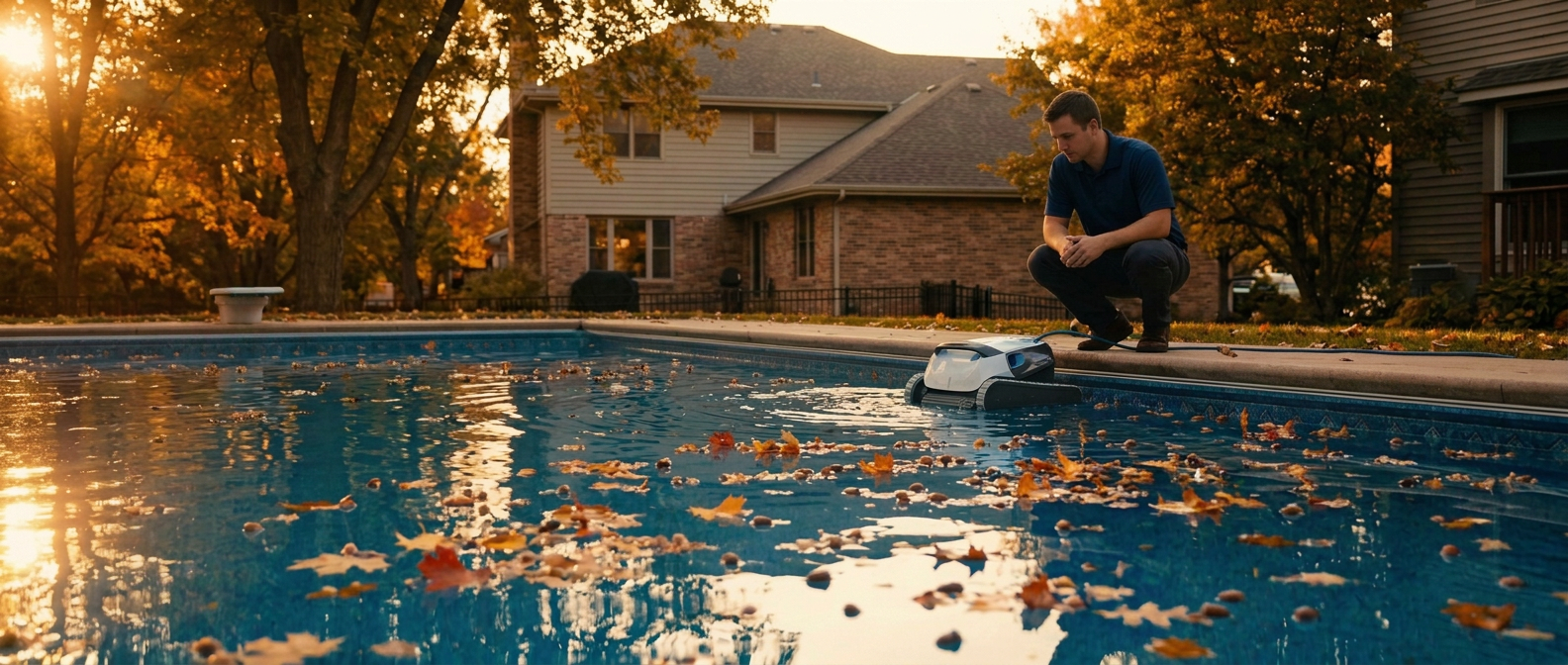
Images are AI generated and do not depict an actual pool or Dolphin Pool & Spa location.
Leaves and acorns are coming down fast around the Twin Cities. Last week we covered how they team with algae to cause trouble in your water. This week, let's look at the tools that clear that debris for you — on the surface and on the floor.
1 Debris Doesn't Stay on Top
A leaf floats for a while. Give it a day of wind and rain, and it sinks. Once it's down there, a net can't reach it. It settles on the floor, tucks into the steps, and sticks to the waterline tile. That's exactly where a robot cleaner does its work.
2 Catch It Before It Sinks
The Dolphin Skimmi 300 works the surface while leaves are still floating, before they get the chance to sink. It's solar powered and cordless. Drop it in a sunny pool and turn it on, and it runs on its own, topping off its charge from the sun as it goes. Switch it to Leaves Capture mode during a heavy leaf week, and its sensors put big floating debris first in line, ahead of smaller particles. Its Edge mode also covers debris that blows up against the walls, so leaves caught along the sides don't sit there either.
It stores enough charge to keep working after dark, so it can finish a heavy week overnight and have the surface clear by the time you want to swim. The filter tray comes in a 4- or 6-liter size — the bigger tray means fewer trips to empty it during peak leaf drop.
Heads up: keep swimmers out while the Skimmi 300 is running. Maytronics warns against swimming with the robot in the water, to avoid an unexpected bump. Run it before or after pool time, not during.
3 Sunk Debris Feeds Algae
Leaves and crushed acorns break down once they're underwater. That breakdown feeds algae and eats up your chlorine. The more organic debris sitting on the floor, the harder your chemicals work just to keep up.
If your chlorine demand jumps this time of year, sunk debris is often the reason. BioGuard Smart Shock and Shock Complete work fast and only need a 15-minute wait before you swim again — but keeping debris off the floor in the first place means you shock less often.
4 Full Coverage Beats Surface Only
Even with a surface skimmer running, some debris still makes it to the bottom before it's caught. That's where a bottom robot cleaner comes in. The Dolphin Eon 100 runs a Full Coverage mode that cleans the floor, walls, waterline, steps, and sun-ledge in one cycle. The Dolphin T2000 uses active brushing and an all-surface climbing brush to scrub walls and floor while it drives. Either way, the robot reaches spots a net never touches.
Signs Fall Debris Is Piling Up
|
What a Robot Cleaner Handles
|
5 Filtered Out, Not Ground Up
Run leaves through your pump and skimmer basket and the impeller chops them into smaller pieces — smaller pieces that are harder to catch and quicker to break down. A robot cleaner pulls debris straight into its own filter instead. The T2000 uses four ultra-fine filter panels; the Eon 100 uses a DebrisLock or Monoblock basket. Both trap fine debris before it ever reaches your pump.
Rinse the filter right after each cycle during a heavy leaf week. Debris that sits and dries is much harder to remove later, and a clogged filter is the number one reason a robot starts missing spots.
Heads up: if you use a liquid clarifier or flocculant, take the robot out of the pool first. Both models warn that these products can clog or damage the filters.
6 Run a Schedule Instead of a Net
The T2000 plugs into a power supply near the pool edge. Long-press the power button and it runs a full week's cleaning schedule on its own through the MyDolphin Plus app. The Eon 100 runs on a battery — no cord to manage across the yard. Its UltraRun mode spreads shorter cycles across one charge and can keep the pool clean for one to two weeks before you need to recharge and rinse the filter. Set the Homing Wall feature once, and it parks itself in the same spot every time, so you're not chasing it around the pool when it's time to take it out. The Skimmi 300 needs even less thought — no schedule to set at all. Leave it in a sunny pool and it works on its own, and the only upkeep is an occasional rinse of the filter tray and the solar panel.
| What It Catches | Effort Required | |
|---|---|---|
| Manual Net | Surface leaves you can see | Netting by hand, ideally every day during leaf drop |
| Skimmi 300 (Surface Skimmer) | Floating debris on the surface and along the walls | Turn it on and leave it in the sun; rinse the filter tray occasionally |
| T2000 or Eon 100 (Bottom Robot) | Floor, walls, waterline, and steps | Set a schedule and rinse the filter basket |
7 Three Ways to Handle Fall Debris
The T2000, Eon 100, and Skimmi 300 each go about it differently — one on a cord and a fixed schedule, one on a battery with no cord at all, and one running on sunlight and never touching the floor. We'll walk through how to pick between the T2000 and Eon 100 in a future article. For leaf season, the point is simple: a surface skimmer catches debris before it sinks, and a bottom robot catches whatever gets past it — together they cover ground a net alone never will.
Ready to Stop Netting Every Day?
Stop by and we'll show you the Skimmi 300, Eon 100, and T2000 side by side. We'll help you match the model to your pool, because we make pool ownership a joy!
 Call Us Now — 763-542-9000

Your Happy Dolphin Pool & Spa Team
Dolphin Pool & Spa — Plymouth, MN